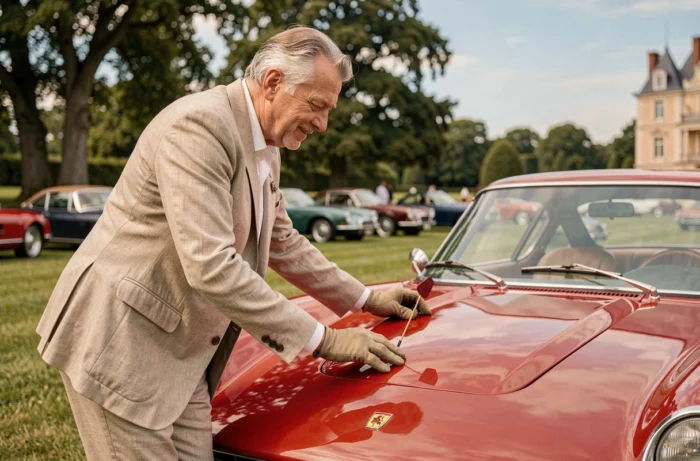
The term gentleman driver originally referred to a wealthy amateur racing driver who paid for his own participation in motor races, as opposed to a professional driver employed by a racing team. Today, the term has broadened to describe any enthusiast who acquires, restores and drives classic cars for the pleasure of it and to preserve mechanical heritage.
This passion comes up against practical realities: in 2026, vehicles eligible for classic status can date back to 1996, bringing models equipped with ABS or airbags into this category, with preservation requirements radically different from those for a 1960s saloon.
Youngtimers and onboard electronics: the technical challenge of newer classic cars
The line between classic and modern cars is becoming blurred. The FFVE is seeing a growing number of 1980s and 1990s models enter the classic vehicle category. These cars contain electronic control units, sensors and engine management systems whose parts are no longer manufactured.
Repairing a Solex carburettor on a Citroën Traction is a matter of traditional mechanical know-how. Diagnosing a fault in the electronic control unit of a Peugeot 405 Mi16 requires specialist equipment and automotive electronics expertise. Not every classic car workshop has this equipment, and manufacturer data for these transitional models can sometimes be impossible to find.
Enthusiasts who document and share their expertise on these vehicles help preserve an evolving automotive heritage, as shown by the community at https://gentlemen-drivers.fr, which brings enthusiasts and experts together around this culture.

This evolution is changing the profile of the gentleman driver. Whereas a pre-war car collector might have mastered welding and setting contact breaker points, anyone taking on a BMW E30 or Alfa Romeo 164 must also understand electrical multiplexing. The passion is the same, but the skill set is expanding.
Classic vehicle registration: practical administrative hurdles
Obtaining classic vehicle status on a registration certificate is not simply a matter of the vehicle’s age. The FFVE processes nearly 40,000 applications a year, and a significant proportion run into gaps in the ownership history.
Common problem cases include:
- A vehicle purchased without the registration certificate being transferred, leaving a gap in the chain of ownership and complicating its administrative identification
- Missing paperwork after a major restoration, particularly when the chassis or bodywork has been replaced without being declared
- An original foreign registration, with documents that may not meet French requirements
These hurdles can turn the purchase of a classic car into a months-long bureaucratic ordeal. A well-informed gentleman driver checks that the administrative paperwork is in order before even inspecting the mechanics.
Roadworthiness testing and classic status: different rules depending on age and classification
The roadworthiness testing rules for classic cars depend on their administrative status, not just their age. Classic cars first registered from 1960 onwards must undergo a test every five years. Those first registered before 1960 are exempt.
One detail escapes many owners: a car over thirty years old that has not been officially designated a “classic vehicle” on its registration certificate remains subject to standard roadworthiness testing—that is, every two years. Classic status therefore eases the burden, but it must be formally granted.
This distinction has direct practical consequences. An owner driving a classic car without classic status faces the same penalties as any other motorist if its roadworthiness test has expired. Classic status offers protection, but also imposes its own restrictions on use.
Using a classic car every day: what classic status effectively prohibits
The image of a gentleman driver taking his classic car to the office every morning is a fantasy. The FFVE points out that classic status is intended for leisure use, not regular commuting.
Insurers follow the same logic. Most specialist classic car policies cap annual mileage and exclude business use. Using a car registered as a classic every day may result in a claim being denied in the event of an accident.
This restriction reshapes the relationship between the enthusiast and their car. Driving becomes an occasion, not a routine. Outings are planned around rallies, gatherings or Sunday drives. Today’s gentleman driver often owns a modern vehicle for everyday use and saves the classic for special occasions.
Preserving a classic car: mechanics, storage and passing on knowledge
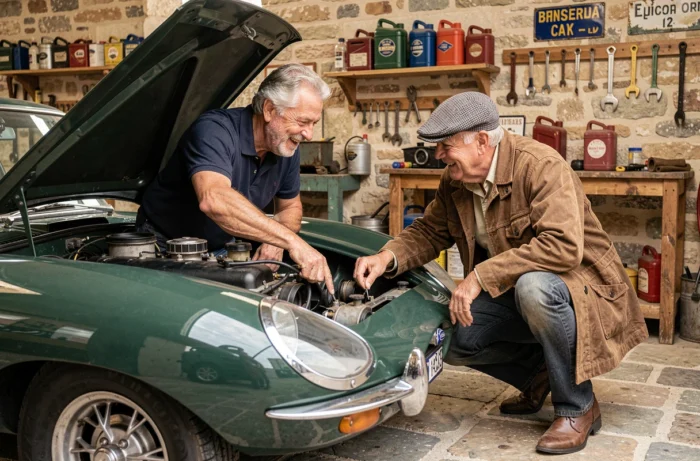
Keeping a classic car in working order requires regular investment that newcomers often underestimate. Beyond the initial restoration, routine maintenance raises specific questions:
- Storing the car in a well-ventilated, temperature-controlled garage helps limit corrosion, but leaving it unused for long periods damages seals, hoses and tyres
- Fluids (engine oil, brake fluid and coolant) must be changed even in a car that is rarely driven, to prevent chemical deterioration
- Spare parts for some rare models command prices far beyond their original cost, and become harder to find every year
Starting the engine regularly and driving a few dozen kilometres each month remains the best way to preserve the mechanics. A classic car left standing for too long deteriorates faster than one that is driven.
Passing on automotive heritage is another important consideration. A classic car represents not only financial value, but also know-how: how to drive it, maintain it and understand its quirks. Without passing on these skills, the car loses part of what makes it come alive.