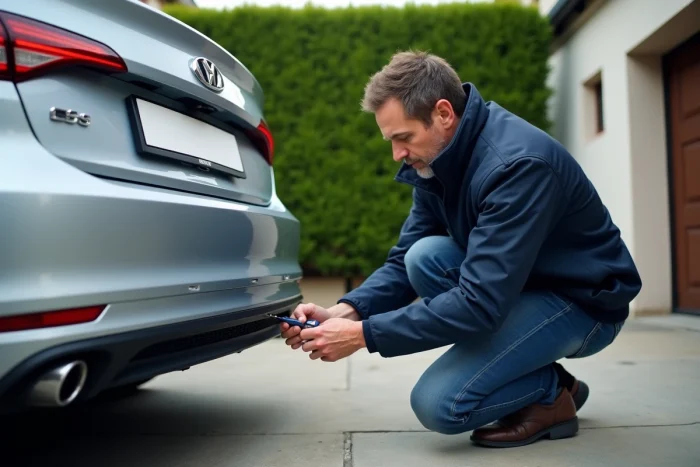
Standard crosshead screws that secure a license plate can be removed in less than thirty seconds with a regular screwdriver. This technical observation explains why the theft of plates remains so simple and why fastening devices deserve attention that most motorists do not give them.
Anti-theft fasteners for plates: screws, rivets, and sealed capsules
The first link in protection is the screws. Anti-theft screws with non-standard heads (secure Torx, pentalobe, proprietary head) replace the original crosshead screws. They require a specific tool that the thief generally does not have on hand.
We recommend models with a one-way tightening direction. These screws screw in normally but cannot be unscrewed, as the head is designed to prevent any reverse rotation. In practice, their removal requires a drill or grinder, which prolongs the operation and makes it noisy.
Aluminum pop rivets are the most deterrent alternative among mechanical fasteners. Once installed, they can only be removed by destroying them. Replacing the plate then requires drilling out the rivet, which also complicates things for the legitimate owner, but ensures that discreet removal is impossible.
Since 2025, Germany has mandated approved fastening systems of the sealed capsule type for all new registrations. This device encases the screw head in a welded plastic shell that breaks if someone tries to force it. France has not yet adopted this requirement, but capsules compatible with the SIV format are available on the market.
For more information on IdentiTools, which lists this type of marking and automotive protection solutions, the process is accessible directly online.

Anti-cut films and chemical engraving marking
Beyond the fastening, the plate itself can be rendered unusable after theft. This is the role of anti-vandalism films and permanent marking techniques.
Anti-cut reflective films are applied to the back of the plate. They adhere irreversibly to the plexiglass support. If someone attempts to peel off or bend the plate to detach it, the film shatters and takes with it part of the retro-reflective coating. The plate then becomes unusable on another vehicle, as it is visually degraded and non-compliant with LAPI control.
Feedback from motorists on specialized forums indicates a proven resistance of these films to common manual tools (flat screwdriver, utility knife blade) since their release in 2025. The film does not protect against a drill, but it makes silent and quick theft significantly more difficult.
Chemical engraving of the VIN number or a unique identifier on the edge of the plate offers an additional layer of traceability. In the event of seizure by law enforcement, a engraved plate allows tracing back to the original vehicle even if it is affixed to another chassis. This marking does not deter theft in itself, but it greatly reduces the interest in usurpation.
Video surveillance and LAPI detection: protecting parking
Physical protection of the plate is not enough if the vehicle regularly parks in unsupervised areas. The parking environment is the second risk factor.
- A surveillance camera aimed at the front and back of the vehicle, even a dummy, alters the behavior of an opportunistic thief. Cloud-connected systems with motion detection send a real-time alert to the owner’s smartphone.
- Dashcams in sentinel mode (parking mode type) record in a loop as soon as movement is detected around the vehicle. Some integrate image analysis capable of distinguishing a pedestrian from an animal, reducing false positives.
- Parking in a closed garage or in a lot equipped with LAPI readers remains the most effective measure. A vehicle parked in a covered and monitored space presents an almost zero risk of plate theft.
For vehicles that park on the street, we observe that the combination of pop rivets and anti-cut film significantly divides the risk compared to a standard fastening without additional protection.
Encrypted digital plates: the French experiment of 2026
A ministerial decree from January 2026 authorized the experimentation of digital license plates with QR encryption in several French regions. The principle is based on a QR code integrated into the retro-reflective coating, cryptographically linked to the vehicle’s registration certificate.
During a check, scanning the QR code by a law enforcement terminal instantly compares the displayed number with the data from the vehicle registration system. If the plate has been placed on a different chassis, the inconsistency appears immediately. This device does not prevent physical theft, but it makes usurpation detectable within seconds during a roadside check or when passing under a LAPI gantry.
The experiment is not yet widespread. We are closely monitoring its deployment, as it could transform the fight against license plate fraud if the results confirm the reliability of encryption under real conditions.
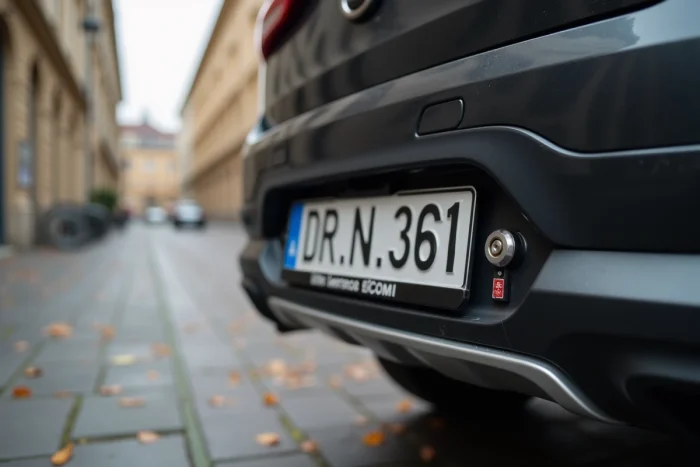
The protection of a plate relies on three complementary levels: the resistant mechanical fastening, the marking or film that renders the plate unusable after theft, and the monitored parking environment. None of these devices is sufficient alone. It is their combination that tips the effort-benefit ratio in favor of the owner, not the thief.