
Food-grade paraffin oil, although permitted for certain uses, is subject to specific restrictions in several European countries and remains absent from the majority of official nutritional recommendations. Despite this, it continues to be used, primarily for technical purposes or for its laxative properties.
Its use is limited to a small number of culinary preparations, often under medical supervision or in the food industry. The claimed benefits come with strict precautions, particularly due to its effects on the absorption of fat-soluble vitamins and a risk of misuse.
Food-grade paraffin oil: origin, composition, and characteristics
Paraffin does not come from the earth or the sea: it is derived from petroleum, refined methodically until a clear, odorless, and stable substance is obtained. In solid form, paraffin wax is used for preservation, while the liquid version, paraffin oil, is distinguished by its purity, suitable for human consumption. If you are wondering what food-grade paraffin oil is used for, know that its neutrality and chemical stability make it a technical asset rather than a culinary ingredient.
This paraffin oil belongs to the large family of mineral oils. It contains no traces of allergens, does not alter the taste of food, and leaves no lingering scent. Its resistance to oxidation and its ability to create a protective barrier make it valuable for preservation. It should still be noted that paraffin is an industrial product, derived from petroleum, although recent research is exploring variants derived from the plant world.
| Characteristic | Food-grade paraffin oil |
|---|---|
| Origin | Derived from petroleum |
| Appearance | Liquid, colorless, odorless |
| Purity | Very high, suitable for consumption |
| Stability | Chemically stable, non-reactive |
Paraffin is composed of hydrocarbons, primarily used by industry. However, the food-grade version meets very strict purity criteria. Its uses are not limited to cooking: it is also used in pharmacy and cosmetics, where its quality is rigorously controlled. Caution is still necessary, as safety depends on the degree of refinement and suitability for the sector of use.
What uses in cooking and digestive health?
Food-grade paraffin oil is primarily found in professional kitchens and the food industry. Its role: to serve as a protective agent and coating for certain products. Homemade jams were once covered with a thin layer of paraffin wax to protect them from air and moisture. This process still exists in some workshops, particularly to ensure long-term preservation. On aged cheeses, a coating of paraffin limits exchanges with the outside, thus preserving aromas and textures. Fruits and vegetables destined for long journeys may sometimes benefit from a discreet coating to prevent drying out.
Here are some examples of the use of food-grade paraffin oil in the culinary profession and daily life:
- Coating of confections: it provides a characteristic shine to candies and chewing gums while remaining neutral on the palate and nose.
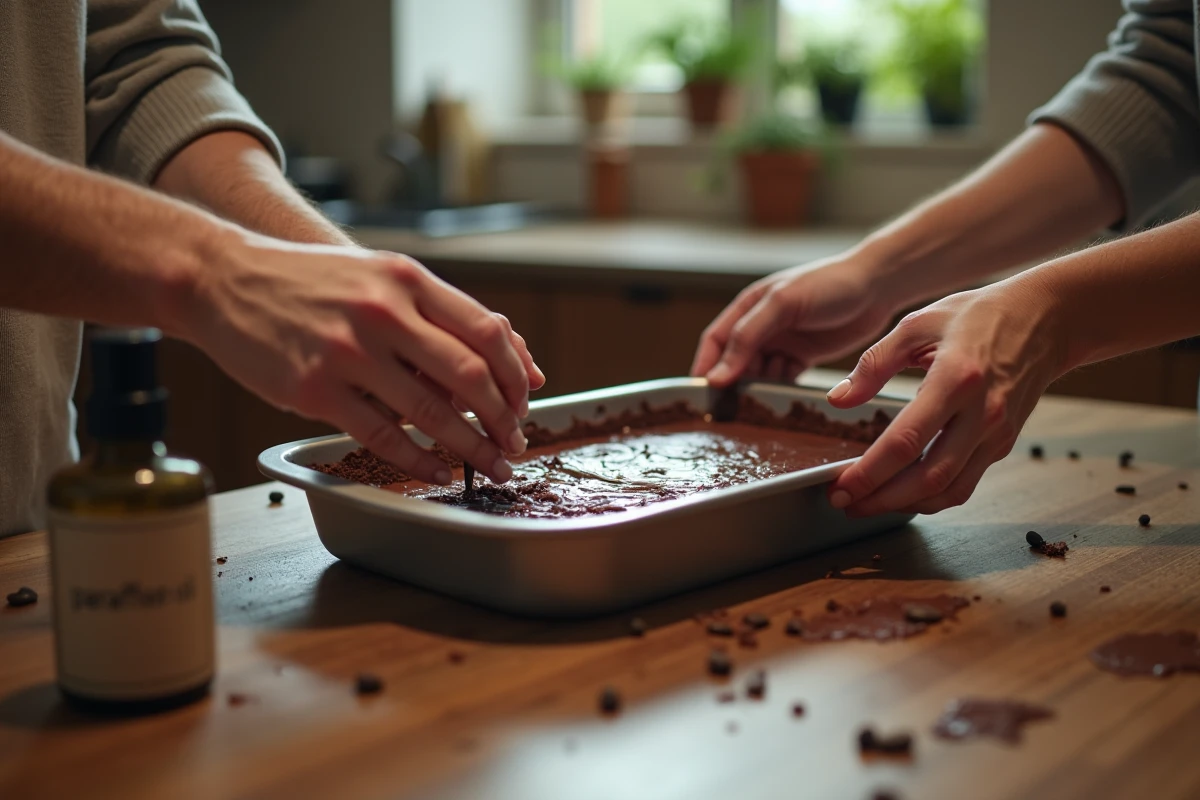
- Protection of cutting boards: applied to wood, it waterproofs the surface and facilitates maintenance.
- Lubrication: it is used for demolding or as a lubricant in machines where there may be indirect contact with food.
In another context, paraffin oil is recognized for its effects on the digestive system. Used as a mechanical laxative, it facilitates intestinal transit by coating stools, which reduces friction and allows for gentler evacuation. This mode of action does not stimulate the intestinal mucosa, unlike other laxatives. It is sometimes prescribed to temporarily relieve constipation, especially in elderly individuals or those with reduced mobility. However, its use requires monitoring: in the long term, it can limit the absorption of fat-soluble vitamins (A, D, E, K), and should always be supervised by a healthcare professional.
Paraffin is also found in certain topical treatments: ointments, suppositories, therapeutic baths. It is then used for its protective properties, particularly in managing joint pain. Caution is warranted: in cases of inflammatory bowel disease (such as Crohn’s disease or ulcerative colitis), in the presence of obstruction, or unexplained abdominal pain, its use should be avoided.
Benefits, precautions, and advice for safe use
Food-grade paraffin oil does not stop at culinary uses. It is found in moisturizers, lip balms, or hair products. Its protective power is explained by the formation of an occlusive film that retains water on the skin’s surface. Paraffin baths are often offered to help relieve pain related to rheumatism, arthritis, or osteoarthritis, while promoting better skin flexibility and healing after burns.
For use on surfaces or in food, it is essential to choose a food-grade paraffin oil, particularly those meeting NSF H1 or NSF 3H standards. This choice guarantees an optimal level of safety, especially when used on countertops, cutting boards, or any wooden utensils that come into contact with food.
Even though it is inert and stable, petroleum-derived paraffin should not be used lightly. Its ingestion is contraindicated in cases of inflammatory bowel diseases, obstruction, or unexplained abdominal pain. In adults without specific pathologies, prolonged use should be avoided, again due to a possible decrease in the absorption of fat-soluble vitamins (A, D, E, K). This is why a doctor’s advice is required whenever paraffin oil is used for self-medication.
Before opting for a food-grade paraffin oil, take the time to carefully review the information on the label. Its lack of odor and taste may be reassuring, but its ability to clog pores advises against applying it to the face daily: the risk of blackheads or blemishes should not be overlooked. Store your bottle in a cool place, away from light, to ensure maximum stability.
Ultimately, food-grade paraffin oil discreetly navigates between industry, medicine, and cooking, oscillating between a practical solution and a product to be handled with discernment. Between its technical uses and its limits, it serves as a reminder that an invisible ingredient is not without impact, and that every action, even seemingly trivial, sometimes deserves special attention.