Most buying guides focus on price and the number of points available. We recommend a different approach to choosing a sewing machine: starting with ecosystem compatibility and reparability, two criteria that determine whether your machine will support you beyond the first few months of practice.
Reparability and spare parts: the criteria that sewing machine guides overlook
A sewing machine becomes unusable as soon as a mechanical part breaks without a possible replacement. Brands that have a network of authorized repairers in France (Singer, Brother, Janome, Bernina, Pfaff) guarantee access to spare parts for several years. Brands sold only in supermarkets or marketplaces, without a structured after-sales service network, pose a concrete problem starting in the second year.
We observe that the availability of spare parts varies greatly by range, even within the same brand. Entry-level models sold exclusively online are often removed from the catalog after a few seasons, complicating the supply of belts, feed dogs, or bobbin holders. Before making a purchase, check that the model is listed in the catalog of a specialized dealer capable of repairing it.
A good reflex is to compare the machines offered on a specialized site like machine à coudre with those available at a local repairer, to cross-reference the two criteria: price and maintainability.
Expandable sewing machine: choose a range compatible with overlockers and embroidery machines
An expandable machine belongs to an ecosystem of shared presser feet, bobbins, and accessories among several models of the same brand. This technical point prevents the need to repurchase everything after a few months of progress.
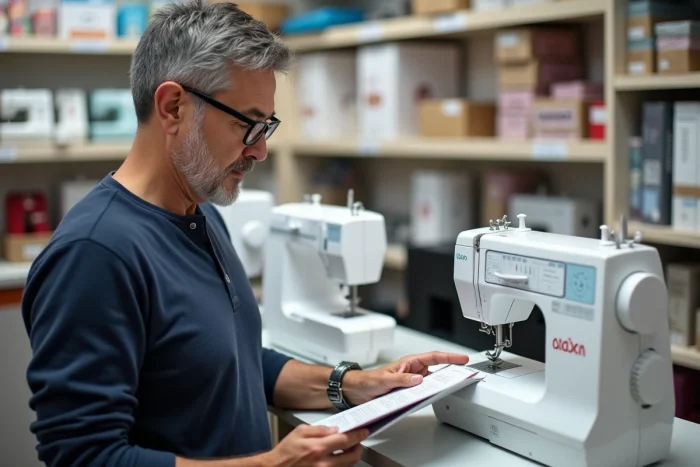
At Brother, clip-on presser feet are interchangeable across almost the entire domestic range. At Janome, the horizontal rotary bobbin system remains the same from entry-level models to intermediate models. At Bernina, the snap-on presser foot is shared between sewing machines and certain overlockers of the brand.
This compatibility has a direct impact on the budget in the medium term:
- Special presser feet (invisible zipper, bias binding, quilting) purchased for a first model remain usable on the next model if you stay within the same range
- Bobbins of the same type avoid unnecessary stock of incompatible consumables when transitioning from a mechanical machine to an electronic one
- Extension tables and storage boxes are often designed for an entire series, not for a single model
We recommend checking the compatibility of the presser foot (clip, screw, proprietary system) before comparing stitch types. The attachment system of the foot determines the real cost of progression much more than the number of stitches delivered out of the box.
Mechanical or electronic: what the choice of motor changes for thick fabrics
Mechanical machines remain relevant for those who primarily sew cotton, linen, and medium-weight fabrics. The stitch selection by dial offers quick handling and simplified maintenance.
On the other hand, electronic models handle stretchy fabrics better thanks to automatic thread tension control and speed regulation. For jersey, fleece, or technical materials, the electronic management of the automatic buttonhole avoids manual adjustments that frustrate beginners.
Recent tests on so-called “heavy duty” machines reveal a nuance that product sheets conceal. Many “thick fabric” models can handle a few layers of denim occasionally, but are not designed for regular use on leather or upholstery. Specialized retailers now distinguish “compatible with occasional thick fabrics” and “professional heavy-duty use” to avoid premature carrier breakdowns.
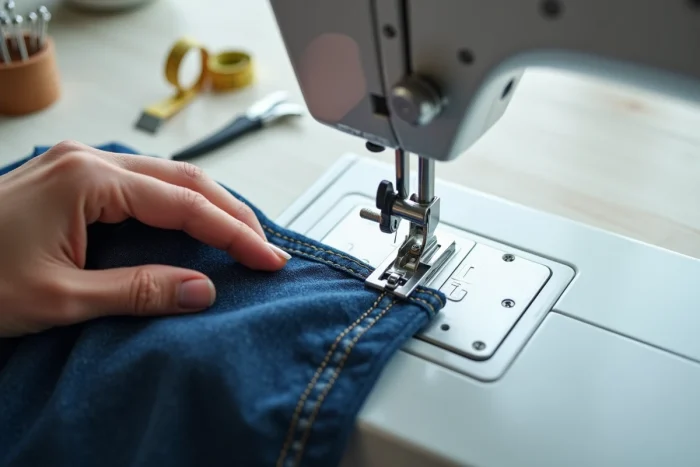
If your projects include faux leather or heavy denim on a recurring basis, it’s better to invest directly in a mid-range machine with a robust feed mechanism and a more powerful motor, rather than pushing an entry-level machine beyond its mechanical capabilities.
Sewing machine budget for beginners: where to set the bar to avoid repurchasing in two years
The entry-level segment (machines sold below the mid-range models) poses a recurring problem: the plastic chassis, lightweight feed mechanism, and lack of fine pressure adjustment limit progress. After a few months of regular sewing, these machines struggle with thicknesses and demanding assembly seams.
We observe a clear trend among specialized retailers to direct motivated beginners straight to mid-range models. The logic is simple: a higher initial investment avoids quick resale and the complete repurchase of incompatible accessories.
The criteria to prioritize for a durable first purchase:
- A partially or fully metal chassis, which reduces vibrations and improves stability on heavy fabrics
- An integrated LED light, often absent from the lowest prices yet crucial for prolonged sewing comfort
- The presence of a speed control (electronic or progressive pedal), which allows for slow work on curves and finishes
- A reasonable number of stitches (about twenty is more than enough) rather than a hundred decorative stitches rarely used
The number of sewing stitches is the most misleading marketing criterion. A machine with about twenty well-calibrated stitches, good fabric feeding, and a solid frame will consistently outperform a model with a hundred stitches mounted on a fragile chassis.
The choice of a sewing machine hinges on the internal mechanics, ecosystem compatibility, and repair network, not on the stitch catalog or the color of the casing. Identifying your target range from the start, checking the availability of parts and presser feet, and then testing the machine on your own fabrics at a dealer: this method remains the most reliable to avoid premature replacement.