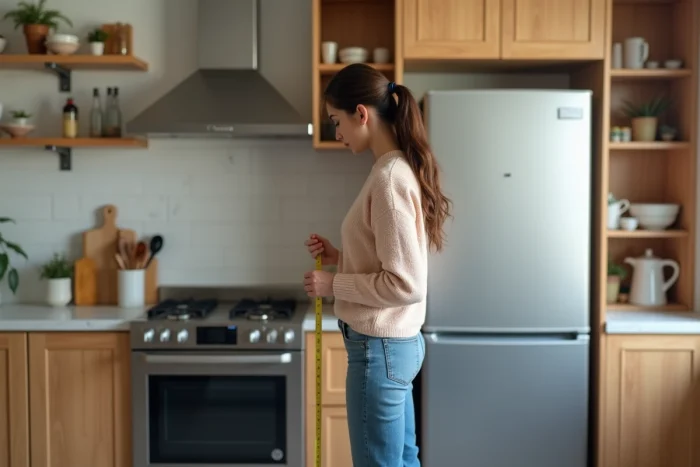
40 centimeters for some, 5 for others: the distance between the oven and fridge resembles an equation without a universal solution. Behind these numbers, one fact stands out. As soon as overheating or condensation makes an appearance, manufacturer warranties vanish, even if the official standard is still awaited.
In the reality of construction sites, some installers sometimes play it tight to gain a few centimeters, even at the expense of peace of mind. However, this proximity can be costly in the long run. The best configuration depends on a subtle balance: power of the appliances, quality of ventilation, and nature of the chosen furniture.
Understanding the stakes of a good layout between oven and refrigerator
Arranging your kitchen is not just a matter of taste. A poor location for the oven or refrigerator can derail the entire organization. The famous activity triangle—cooking, washing, storage—is not just a designer concept: it makes every action simpler, every movement more logical. But this triangle adjusts according to the size of the room, the height of the furniture, and the choice between freestanding or built-in appliances.
The heat from the oven poses a real challenge. If the oven and fridge are too close to each other, performance drops, electricity consumption rises, and the fridge’s energy label loses all meaning. Inserting a worktop or an intermediate piece of furniture limits the damage. The ideal distance between oven and fridge then becomes a point of vigilance, at the intersection of economic and safety concerns.
Daily life also imposes its rules: preparing, cooking, storing—nothing should obstruct movement. On the worktop, appliances must find their place without blocking access to storage or forcing unnecessary contortions. Built-in models, designed to fit the space, provide a real advantage, provided that ventilation is well-planned and the layout is thought out in advance.
Finally, safety allows for no compromise. Overheating, burns, condensation: these are all avoidable risks by adjusting the height of the appliances and choosing each location with care. A coherent layout, respecting the proper distance between the oven and fridge, lays the foundation for a reliable and pleasant kitchen.
At what distance should the oven be placed from the fridge for a practical and durable kitchen?
Making the oven and refrigerator coexist in the same room requires method and precision. The goal is simple: to prevent the heat from the oven from disrupting the cooling cycle of the fridge. Poorly controlled heat can compromise the refrigerator’s efficiency and shorten its lifespan. Manufacturers generally recommend a minimum of 5 cm of space on the sides and back of the fridge, and 10 cm above to ensure good ventilation. This margin limits the risks of overheating and protects the refrigeration system.
In a kitchen equipped with custom furniture or built-in appliances, it is essential to ensure that these spacings are respected. A dedicated unit for the refrigerator must include appropriate ventilation to allow air to circulate freely. The oven should be installed at a reasonable distance, neither too close nor too far, to maintain the ergonomics of the worktop and the organization of the activity triangle.
The configuration of the room also weighs in: linear, L-shaped, U-shaped… each shape has its logic. Installing the oven at eye level offers comfort and safety; placing the fridge for direct access makes daily life easier. Avoid placing these appliances next to the sink or cooktop, and keep these layout rules in mind to reconcile safety, energy performance, and longevity of the equipment.

Common mistakes to avoid and tips for optimizing space without compromise
Too often, the oven ends up wedged against the refrigerator or another appliance, without any real overall consideration. This proximity harms thermal insulation, accelerates wear on the appliances, and multiplies repair interventions. Another misstep: installing the oven too low or the fridge too high. The result? Handling becomes difficult, and the risk of accidents increases.
The space between the worktop and the upper cabinets deserves to be anticipated. To ensure safety and ease of use, it is advisable to leave at least 50 cm. Here are the points to check to leave nothing to chance:
- Ensure that electrical outlets remain accessible but far enough away from sources of water and heat
- Lighten the backsplash to prioritize movement: eliminate unnecessary accessories that hinder movement
To optimize space without compromising efficiency, adapt the layout to the configuration of the room. In a linear kitchen, group work areas for more coherence; in L or U shapes, distribute cooking, washing, and storage areas according to the principle of the activity triangle. A central island can structure the space and create an anchor point, provided it does not obstruct movement. Enhance natural light, then add targeted lighting over the worktop and preparation areas for everyday comfort.
Successfully arranging your kitchen means finding the balance between technical constraints and ease of use. When each appliance occupies its rightful place, the room breathes, and daily actions become smoother. A well-thought-out kitchen also ensures that appliances last and creates a space where it is pleasant to live, day after day.